
Suicide and Mental Health in United States
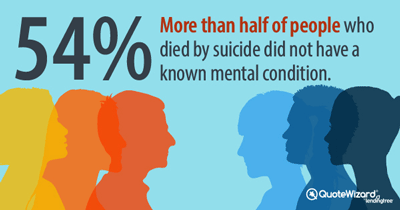
Mental health problem is one of the key factors leading to an increase in suicide. Both the WHO and the UN have recommended that member states should develop national suicide– prevention programs, where possible linked to other public health policies, and that they should establish national committees to coordinate the prevention strategies (Jenkins, 2002). Suicide as a result of mental health continues to be a major public health problem in the United States (US), with 30,000 deaths per year (D’Orio & Garlow, 2004). According to Gapminder (2013), US spends more per capita (GDP) — mental health of suicide per (100,000 people) which proved to be more than other industrialized countries like Netherlands, Portugal, Italy, Brazil, Jordan, Greece, and majority of the European countries, etc. Chan (2011) also identified a detailed state by state percentage of population who has suffered mental illnesses. The detailed lists showed Rhode Island, Utah, Idaho, West Virginia and Indiana with the most percentage for exhibiting mental health issues; while Maryland, Pennsylvania, North Dakota, Florida, and Illinois experienced lesser forms of mental health. Likewise, the report defined mental health issues as any social, mental and expressive syndrome that is identifiable from the DSM-IV. Suicide prevention research have received substantially fewer public resources than many other medical conditions, and apparent public health risks, such as bioterrorism. It is for this reason that a comprehensive, national public health-based suicide prevention program is required.
Chan, A. (2011). America’s Mental Health, State by State. Huff Post Healthy Living. Retrieved from http://www.huffingtonpost.com/2011/10/13/mental-health-states-america_n_1007844.html
D’Orio, B., & Garlow, S. J. (2004). SUICIDE PREVENTION: A VITAL NATIONAL PUBLIC HEALTH ISSUE. Journal of Health and Human Services Administration, 27(1), 123-41. Retrieved from http://search.proquest.com/docview/199991800?accountid=14872
Gapminder. (2013). Gapminder world offline. Retrieved from http://www.gapminder.org/world-offline/
Jenkins, R. (2002). Addressing suicide as a public health problem. The Lancet, 359 (9309), 813-4. Retrieved from http://search.proquest.com/docview/199001042?accountid=14872

